Friday, April 30, 2010

Adobe Creative Suite 5 Now Shipping, Free Trials Available

Friday April 30, 2010 03:29 AM EST
Written by Eric Slivka


Adobe today announced that it has begun shipping Creative Suite 5, introducedearlier this month.

Adobe Systems Incorporated (Nasdaq:ADBE) today announced the availability of the Adobe Creative Suite 5 product family, the highly-anticipated release of the industry-leading design and development software for virtually every creative workflow. With more than 250 new product features, the Creative Suite 5 product line brings exciting full-version upgrades of flagship creative tools and workflow enhancements to designers and developers -- enabling the creation, delivery and optimization of content across media for greater impact and results.

Adobe is now offering free trial downloads for Creative Suite 5 and its various components. CS5 is also available at Amazon for slight discounts.

Note: Sales through these links financially benefit this site.

Thursday, April 29, 2010

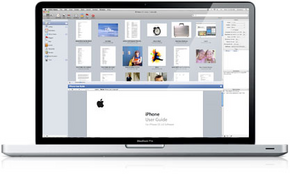
SOHO Notes 8.32


SOHO Notes is the premier digital note-taking application for Macintosh. Use it to capture, organize, and share all of your personal and workgroup information. It can store rich text, PDF's, images, files, movies, audio, bookmarks, and web archives. Synchronize notes between multiple computers, iPod's, and Palm handhelds.
Single And Multi-User Capable - SOHO Notes is as equally suitable for the more...
WHAT'S NEW
Version 8.32:

- Added a Cancel Sync button to the Sync Preference pane
- Added an indicator to the Sync Preference pane that shows the number of pending changes to sync
- Add auto-repair feature for form notes that have lost their form definition
- Significant speed improvement when syncing with Sync Services
REQUIREMENTS
Mac OS X 10.5.5 or later.

iPad Competitors Begin to Disappear Even Before Being Released

Thursday April 29, 2010 04:37 PM EST
Written by Eric Slivka


Microsoft's "Courier" booklet-style tablet concept

Silicon Alley Insider yesterday noted that HP appears to be putting its "slate" tablet computer on hold as it looks to complete its acquisition of Palm. The move appears to be related to HP needing to make decisions about how exactly it will integrate Palm's webOS smartphone operating system into its product roadmap.

An analyst asked what HP would be doing with its iPad-rival. HP's Todd Bradley responded, "We haven't made roadmap announcements," but that HP will explain its Slate plans in more detail when the Palm deal closes.

That's at least a few months away: HP expects the deal to close during its fiscal third quarter, which ends at the end of July. And building Palm's WebOS operating system into HP tablets could take much longer -- perhaps even a year or more.

HP's slate, previously destined to use Microsoft Windows, was demoed by Microsoft CEO Steve Ballmer in early January, several weeks before Apple introduced the iPad. The following month, HP indicated that it was refining the final specs of the slate in response to the iPad and looking to price it competitively with Apple's tablet device.

Today, Gizmodo reports that Microsoft has cancelled its own "Courier" booklet-style tablet device.

We're told that on Wednesday, Microsoft execs informed the internal team that had been working on the tablet device that the project would no longer be supported. Courier had never been publicly announced or acknowledged as a Microsoft product.

The cancellation was confirmed in a response from a Microsoft representative, who noted that Courier was one of the company's creative explorations of new form factors and interfaces, but that it is not planned to go into production. The Courier concept offered two touch-sensitive screens in a foldable format and incorporated touch, stylus, and handwriting recognition input.

Finder of Lost Next-Generation iPhone Identified

Thursday April 29, 2010 06:39 PM EST
Written by Eric Slivka

Wired reports that it has identified the person who last month found a next-generation iPhone in a Redwood City, California bar and later sold the device to Gizmodo.

Brian J. Hogan, a 21-year-old resident of Redwood City, California, says although he was paid by tech site Gizmodo, he believed the payment was for allowing the site exclusive access to review the phone. Gizmodo emphasized to him "that there was nothing wrong in sharing the phone with the tech press," according to his attorney Jeffrey Bornstein.

While the San Mateo County District Attorney's Office has spoken with Hogan and is continuing to examine the case to determine whether criminal charges are warranted, Hogan has yet to be charged with any crime.

According to the report, Hogan was only able to access the device's Facebook application before it shut down, and only later did he discover that he was in possession of a prototype device. A friend of Hogan's reportedly called AppleCare on Hogan's behalf in a failed attempt to return the iPhone, which appears to be the extent of Hogan's effort to return the phone to its owner.

"He regrets his mistake in not doing more to return the phone," says Bornstein's statement. "Even though he did obtain some compensation from Gizmodo, Brian thought that it was so that they could review the phone."

After Gizmodo published a feature article on the next-generation iPhone, Apple representatives attempted to search Hogan's home, but were turned away by a roommate. Law enforcement officials then became involved in the situation at therequest of Apple. In addition to Hogan, investigators have also focused onGizmodo editor Jason Chen, seizing a number of items from his residence in what the Electronic Frontier Foundation calls an illegal search.

Update: CNET reports that it has identified UC Berkeley student Sage Wallower as the "middleman" who contacted tech sites on Hogan's behalf regarding the lost iPhone. CNET also believes that there was a third person involved in the situation.

In an in-person interview with CNET at his home in Oakland on Thursday, Wallower said, "I'm not the person who found it. I didn't see it or touch it in any manner. But I know who found it." He declined to identify anyone else, however, in part because he said conversations with law professors had convinced him that Apple was a "legal juggernaut."

"I need to talk to a lawyer," Wallower said. "I think I have already said too much."

Apple drops Mac category from annual design awards


The Apple Design Awards, which recognize the best software created by third-party developers for Apple platforms, are among the most coveted honors in the Mac community and developers weren't shy about voicing their disappointment over the lack of Mac.Third-party developers heaved a sigh of relief this morning as Apple finally announced the dates for its 2010 Worldwide Developer Conference. But that sigh was quickly followed by a raised eyebrow of curiosity as they noticed that Apple had dropped the Mac software category from its long-running Apple Design Awards. Instead, the awards will cover only iPhone and iPad applications available on the App Store.

"I think it's a mistake for Apple to miss such an easy opportunity to acknowledge Mac developers," says Red Sweater Software proprietor Daniel Jalkut. "While the iPhone and iPad are understandably hot right now, the Mac is still a huge part of Apple's business, and Mac developers are important in sustaining that."

Rogue Amoeba CEO Paul Kafasis agrees. "Ultimately, I find these moves disappointing. Having an iPhone slant at WWDC is one thing, but completely cutting the Mac out of the ADAs? That feels like a snub to plenty of Mac developers who continue to do great work on a well-established, popular platform."

While ADAs are handed out every year at WWDC, the list of categories change to take into account Apple's latest technologies. In 2005, for example, Apple recognized "Best Mac OS X Tiger Technology Adoption"; in 2006, "Best Automator Workflow." iPhone apps were first given awards in 2008, a month before the App Store's debut. But while iPhone and iPad apps are clearly the topic of the moment in 2010, it would also have been the first year for showing off apps that take advantage of features in the latest version of Mac OS X, Snow Leopard, which debuted last August.

The ADAs aren't the only place that the Mac seems to have gotten short shrift. Apple's dubbed WWDC 2010 "the center of the app universe" and the list of sessions reference "how to harness the revolutionary technologies in iPhone OS."

Apple's also reorganized the conference's structure, which in the past has been divided up into tracks for the company's various platforms and other general topics: iPhone, Mac, IT, and so on. This year, Apple's taken a technology-centric approach, dividing its session up into topics on Application Frameworks, Core OS, Developer Tools, Graphics & Media, and Internet & Web.

Given that Apple has already shown off iPhone OS 4.0, which is due to be released this summer, it's not necessarily a surprise that the bulk of WWDC would focus on iPhone development. The next version of the Mac OS X, on the other hand, hasn't yet seen the light of day, and some estimate that it's still a year or more away.

"This year, because of their focus on iPhone and iPad, there isn't anything exciting to sell about Mac OS X," says Red Sweater's Jalkut.

"I don't think we'll see any information Mac OS X 10.7 at all," says Kafasis. "Apple clearly wants to focus on iPhone OS."

There's also the recent introduction of the iPad, which is undeniably a hot property at the moment. It also means that half of Apple's major product lines—the Mac, iPod, iPhone, and iPad—run the iPhone OS. And the iPhone alone makes up a major portion of the Apple's revenue; last quarter, it accounted for 40 percent of the company's $13.5 billion income.

Mac OS X isn't wholly absent from the 2010 proceedings. There are several WWDC sessions that deal specifically with the Mac, such as "I/O Kit Device Drivers for Mac OS X," and "OpenGL for Mac OS X," and several of the other session descriptions put the Mac on even footing with the iPhone OS. And of course, since the Mac and iPhone operating systems share an underlying foundation, many of the sessions apply to both platforms.

But the shift towards the iPhone is undeniable, and when coupled with other recent concerns, such asthe lack of updates to Apple's popular Mac OS X Downloads page, some developers are uncomfortable with the message that Apple seems to be sending. "Is that intentional, or are we reading too much into it?" wonders Kafasis. "It's impossible to say, but it's all we have to go off of for now."

That said, Kafasis doesn't find the move surprising, given Apple's sometimes tumultous—and often close-mouthed—relationshp with third-party developers. "At times, they've needed us—to help keep the company afloat in the late '90s, to get people to try Mac OS X (and leave Mac OS 9), to move people to Intel from [PowerPC]. But when they don't need us, it often feels as though they don't really want us either. I think that in the mind of Steve Jobs, the Mac is largely complete, without any third party applications."

Despite the shift in focus, Mac developers seem more irked than worried for the future of their platform. After all, Mac sales have been steadily growing over the last several years, with 2.94 million computers sold in the last quarter and repeated record-setting Mac sales.

"The iPhone OS is certainly bigger than Mac OS X now, and that's incredible," Kafasis says. "That doesn't mean the Mac is suddenly irrelevant, however."

"It's not the end of the Mac, or even indicative that Apple doesn't care about supporting Mac developers," adds Jalkut. "Apple just gets this annoying tunnel vision sometimes and this is a perfect example of that."

Next Generation iPhone to Use 5-Megapixel Camera?

Thursday April 29, 2010 12:18 AM EST; Category: iPhone
Written by arn


Chosun reports (via AppleInsider) that Apple's next generation iPhone will use a 5-megapixel camera provided by LG Innotek.

The electronics component maker began producing the sophisticated cameras at its plant in Gumi this month and will mass produce them starting in the second half of this year.

The current iPhone 3GS offers only a 3-megapixel camera at this time. There had been earlier rumors in 2009 also placing a 5-megapixel camera in the next iPhone, but those rumors pinpointed a different supplier. 

Apple is expected to unveil the next iPhone at WWDC in June.

Wednesday, April 28, 2010

Apple Announces WWDC 2010 Dates: June 7-11

Wednesday April 28, 2010 09:17 AM EST
Written by Eric Slivka


Apple today announced that this year's Worldwide Developer Conference (WWDC)will take place from June 7th through 11th at San Francisco's Moscone West convention center.

The Apple Worldwide Developers Conference (WWDC) is the premier technical conference for developers innovating with Apple technologies. Over 1,000 Apple engineers will be at Moscone West to present advanced coding and development techniques that will show you how to enhance the capabilities of your applications with the revolutionary technologies in iPhone OS and Mac OS X.

As always, the conference will include technical sessions and hands-on labs for attendees, as well as other special events. Registration for the conference is priced at $1599, with tickets for the conference having sold out increasingly quickly over the past couple of years. Given the short lead time on ticket sales this year, developers will likely have to move quickly to secure a spot in the conference.

Apple is widely expected to introduce its new iPhone hardware during a keynote address at the event, although the device has already received considerable publicity since Gizmodo published details on one lost by an Apple employee in a California bar.

Update: A number of observers have noticed a heavy emphasis on iPhone OS in this year's conference, from the headline banner featuring App Store application icons to the elimination of Mac OS X as a category in the Apple Design Awards. AsDaring Fireball's John Gruber notes, the iPhone OS emphasis strongly suggests that Mac OS X 10.7 will not be previewed at the conference.